
Check Olney Voter Registration
The free Maryland Voter Lookup is the first stop for an Olney voter checking a personal record. It requires several identity facts and does not offer open name browsing. The service needs no account and says its data is refreshed each day, although a submission made that same day will not appear yet. Online or motor-vehicle registration submissions may need up to three weeks to post.
| Field label | Type | Required | Format/instructions |
|---|---|---|---|
| First Name | Text | Yes | As on registration; letters and spaces only |
| Last Name | Text | Yes | As on registration; letters, hyphens, and spaces only |
| Date Of Birth - Month | Numeric text | Yes | Number 1-12 |
| Date Of Birth - Day | Numeric text | Yes | Number 1-31 |
| Date Of Birth - Year | Numeric text | Yes | Portal validation displayed an accepted range of 1921-2010 when inspected July 19, 2026 |
| Zip Code | Text | Yes | Exactly five numeric characters; use ZIP of the Maryland residential address on the registration |
| Street Number | Text | No | Residential street number; letters and 1/2 indicators are not necessary; accepts numbers, letters, commas, hyphens, and forward slashes |
| Middle Initial | Text | No | One alphabetic character, as registered |
A match lets the voter review registration status, find a polling place and districts, identify the local board, check mail-in or provisional ballot status, view a sample ballot, and request a duplicate registration card. Those functions make it an authenticated voter lookup service, not a public people directory. For matters beyond the lookup, contact the Montgomery County Board of Elections.
The required birth date and residential ZIP serve as matching inputs. They are not proof that those same details will be released in a public voter file. That distinction is central to Olney voter registration records: a person supplies private facts to reach a personal result, while the state controls which fields appear in a separate authorized data product. Optional street number and middle initial can narrow the match when names are similar.
Use the five-digit ZIP tied to the Maryland residential address on the registration. The portal accepts letters and spaces in the first name, and letters, hyphens, and spaces in the last name. The street-number field can accept numbers, letters, commas, hyphens, and forward slashes, although the instructions say letter and one-half indicators are not needed. These format rules help avoid a false miss caused by punctuation or an address entered in a form the lookup does not expect.
Fix an Olney Voter Lookup Miss
A failed search does not prove that a voter record was cancelled. Maryland’s own tips call for checking how the record was filed. Try the full registered first name rather than a nickname. After a move, use the former ZIP code. After a name change, test the former registered name. A new application may also still be within the stated processing window.
If those checks fail, call the Montgomery County Board of Elections at 240-777-8500. A business address or post office box cannot serve as the residence address, though either may be used as a mailing address where allowed. County guidance asks voters to report a name, address, or party change within 30 days, online or through a signed written update.
Written updates should include the voter’s birth date, original name, address or party, the requested change, and a dated signature. The county accepts those updates by mail or fax. This direct correction route is better than repeating guesses in the lookup because staff can compare the submitted facts with the registration system and explain what must be changed.
Note: Treat a no-match result as a prompt to verify the filed details and timing, not as proof of a registration status.
Olney Voter Records Custodian
Olney is an unincorporated community, so voter records are kept by Montgomery County and Maryland, not an Olney city office. The Montgomery County Board of Elections receives visitors at 18753 North Frederick Avenue, Suite 210, Gaithersburg, and mail at P.O. Box 4333, Rockville, MD 20849-4333. It is open Monday through Friday, 8:30 a.m. to 5 p.m. The main number is 240-777-8500, and the 24-hour information line is 240-777-VOTE (8683).
County Registration Desk
Email Voter.Registration@montgomerycountymd.gov or fax 240-777-8600 for registration service and registry-view applications.
State Data Desk
Maryland SBE handles list applications at 410-269-2840 or 800-222-8683 and dlPSR_sbe@maryland.gov.
MC311 provides another county routing channel at 311 within Montgomery County or 240-777-0311 from outside the county, Monday through Friday from 7 a.m. to 7 p.m.
The county’s elections service page shows the local routes available to Olney residents.
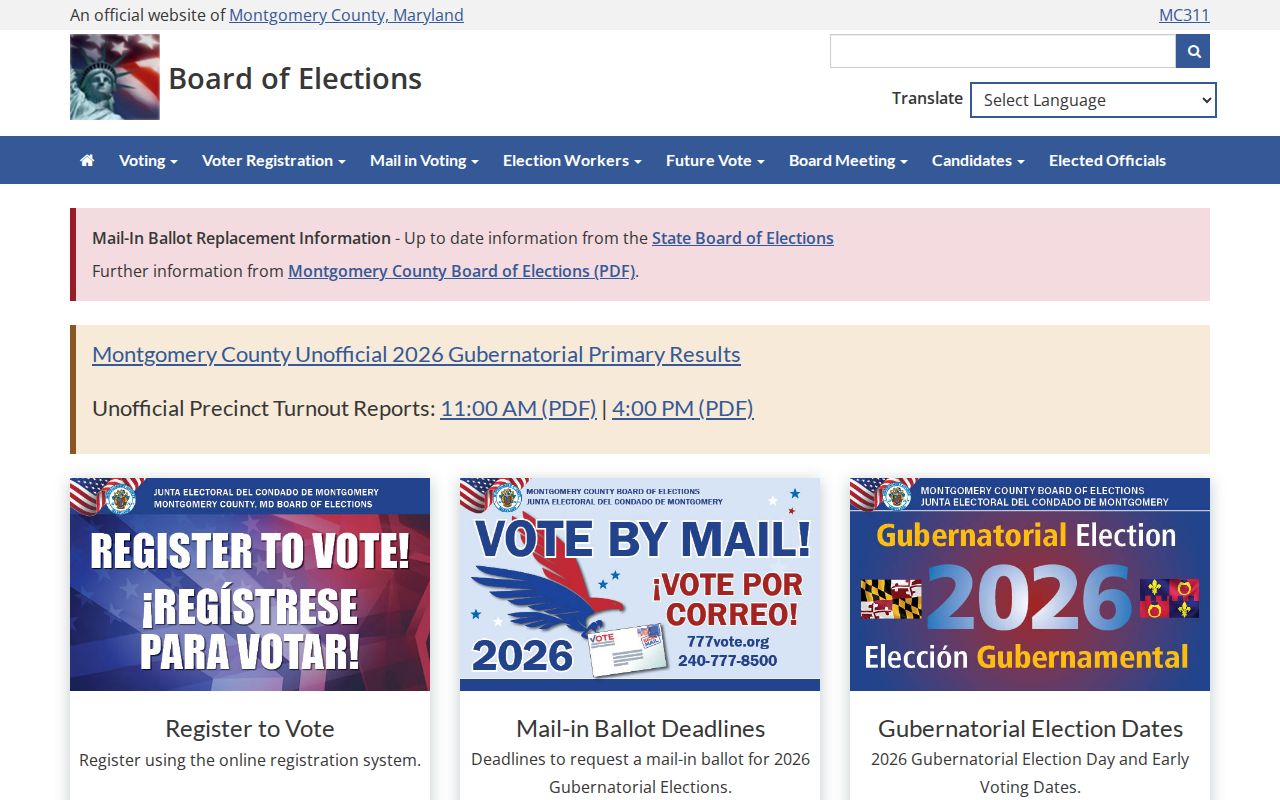
The captured county page confirms that local voter help is organized at the Montgomery County level rather than through a municipal Olney desk.
County products include a voter notification card and a certification of registration embossed with the county seal. Each costs $1. A duplicate notification card also costs $1, with cash or check payable to Montgomery County, Maryland, and mail orders require advance payment. The notification card states the voter’s name, address, party affiliation, polling place, and election districts. If it has not arrived within three weeks, the county directs the voter to call its main elections number.
Fields in Maryland Voter Records
The statewide registered-voter product contains more fields than the private self-lookup displays. It can identify a voter, place the registration in its election geography, and distinguish an active record from an inactive one. Voting history records participation, not choices made on a secret ballot. Maryland also registers voters by party, so party appears on the list and helps determine primary ballot style.
Election geography can be detailed. The product inventory includes the split and precinct as well as congressional, legislative, councilmanic, ward, municipal, and commissioner districts when applicable. Olney has no municipal government, but the statewide file retains a common format for all jurisdictions. A general-election ballot style depends on residence, while a primary style depends on both residence and party.
| Name and voter ID | Identity fields in the registered-voter list |
|---|---|
| Residential and mailing addresses | Both may appear, subject to protected-address suppression |
| Party and gender | Listed in the state product inventory |
| Registration dates | State and county registration dates |
| Status | Active or inactive |
| Election geography | Precinct, split, county, and applicable legislative or local districts |
| Voting history | Election participation and method, never ballot selections |
Confidential by law. The public product does not list birth date, driver’s-license or state-ID number, Social Security number, signature, or registration-agency identity. Election Law §3-506 also requires suppression of an Address Confidentiality Program participant’s residence.
Inspect Olney Voter Registration Records
Election Law §3-505 provides an in-person route distinct from the online self-lookup. Voter registration records retained in a local board office are open to inspection. Original records generally must remain available while the board is open and cannot leave the office except under a court order or for temporary data processing.
Montgomery County links an Application to View the Voter Registry from its election products page. A completed request may be mailed to the board, emailed to Voter.Registration@montgomerycountymd.gov, or faxed to 240-777-8600. For other existing election records that do not fit a standard product, the State Board accepts a public-information request by email, mail, or phone. That route seeks records the agency already holds; it does not require staff to create a new report.
The State Board receives those public-information requests at pia.sbe@maryland.gov or P.O. Box 6486, Annapolis, MD 21401-0486. Its election-record process is narrower than Maryland’s general public-record framework because election statutes set special inspection, confidentiality, applicant, and use terms. General access-law procedure is addressed with the broader Olney public records system.
Protected Olney Voter Addresses
Maryland’s Safe at Home Address Confidentiality Program gives eligible participants a substitute legal address and forwards qualifying mail. Government agencies generally must accept that substitute address. For voter rolls, state law directs election officials to suppress the participant’s residence address without requiring a separate voter-file protection request.
The State Board’s voter forms page also lists a confidentiality request form updated March 3, 2025. Saved older forms should be replaced with the current version. These controls matter because public access to some voter data never cancels the legal duty to protect a confidential address.
Section 3-505 withholds two other facts: that a person declined to register and the identity of the registration agency through which a specific person applied. The public registered-voter inventory also omits signatures and the sensitive identifiers used to establish or match a registration. An open inspection rule therefore does not mean every field collected during voter registration becomes public.
Safe at Home is administered by the Maryland Secretary of State. The program assigns a substitute legal address unrelated to the participant’s actual residence and forwards first-class, certified, and registered mail as well as service of process. Participants may use the substitute address when registering to vote and in other government dealings. This protection follows the address into the released voter data rather than relying on a requester to notice and remove it.
Note: Protected-address rules apply to released voter data even when other fields in the same registration record remain available.
Request Maryland Voter Rolls
A voter file is not a general people-search product. Under Election Law §3-506, only a registered Maryland voter may apply and swear that the data will serve the electoral process, not commercial solicitation or another non-electoral use. The current State Board voter-data application prices one county, municipality, or district at $75 and statewide data at $125.
- Enter the applicant’s name, phone, residential address, and organization details when buying for an organization.
- Describe the electoral use, choose the region, list type, voter subset, and delivery method, then sign the perjury-backed oath.
- Send full payment with the application. Choose free FTP delivery, pickup, mail, or a flash drive for an added $15.
Except for a PDF walking list, the output is tab-separated text without text delimiters. Maryland does not provide custom formatting or import help. The stated turnaround is within 10 working days after receipt, but pre-election applications must arrive by the advanced-registration deadline. Knowing non-electoral use is a misdemeanor. The form states a possible term of 30 days to six months, a fine up to $250, or both.
Applicants may pay by credit card, certified check, personal or campaign check, or money order. Checks are payable to the Maryland State Board of Elections, and a returned check adds a $30 fee. The State Board is at 151 West Street, Suite 200, Annapolis, MD 21401. Large statewide or district files may exceed common spreadsheet or desktop database limits. The applicant must plan for the tab-separated format because the State Board will not build a custom export.
The request form also lets an applicant narrow a product to active voters, a registration-date range, selected parties, or all registered voters including inactive records. Voting-history requests can name elections, while event-specific products cover mail-in applicants, provisional voters, early voting, and cure records. The oath bars distribution, sale, or transfer as well as commercial and other non-electoral use. Those terms follow the data after delivery, so paying the fee does not create unrestricted reuse rights.
Choose an Olney Voter Product
The registered-voter list is only one product. A precinct-based walking list sorts street addresses and places even and odd numbers on opposite sides of its PDF layout. Separate history can be joined to a registration file by voter ID. Mail-in applicant, early-voting, provisional, and cure products carry fields specific to each election process.
| Product | Key content | Important limit |
|---|---|---|
| Registered voters | Identity, addresses, party, status, dates, precinct, districts | Protected addresses are suppressed |
| Walking list | Precinct and street-sorted voters with party | Not sold statewide |
| Separate voting history | Election, method, date, precinct, and county | No ballot choices |
| Mail-in applicant | Request status, addresses, party, and districts | A request does not prove the person voted |
Montgomery County reports its products as of the first day of the month and can organize countywide data by council district, Board of Education district, or party. That date and selection matter when comparing two copies of Olney voter records.
The county also provides election-geography products apart from the voter roll. Polling-place lists are online, while a hard copy costs $1.50. Available maps cover congressional, legislative, councilmanic, Board of Education, and precinct boundaries. A small precinct map costs 25 cents, a large county or district map costs $20, and small countywide maps are free. Mailing can add tube and postage costs.
Each specialized list answers a different question. A mail-in applicant row can show a request and its status, but the state warns against treating that request as proof of voting. Actual participation belongs in voting history. A provisional list may include status and reason fields, precincts, districts, and ballot-style details. A cure list concerns returned mail ballots that lacked an oath signature at extraction time. None of these administrative facts discloses how the voter marked a ballot.
Olney Voter Roll Maintenance
Active, inactive, and cancelled are record states with defined maintenance processes. The State Board’s list-maintenance explanation says Maryland follows federal and state rules, receives daily registration data from other states, and receives Maryland Department of Health death records each month. Death cancellations load into MDVOTERS, after which local boards have five business days to complete the cancellation.
This process is another reason not to infer status from a single failed lookup. A recent move, name update, registration submission, or data-maintenance event may change what appears. The correct next step is to check the registered details and contact the county board, not to guess why a record did not match.
Accuracy-program records have their own retention rule. Election Law §3-505 requires at least two years of retention, with the specified declined-registration and registration-agency facts still withheld. Active or inactive status should also be read as an administrative field, not as a statement about how a person voted. Participation appears only in the proper history product, and no history product reveals ballot choices.
Historical Olney Voter Records
Modern voter lookup tools answer present-day questions. Family historians need a different channel. The Maryland State Archives catalog and Montgomery County Board record groups are the right places to search for poll books and election returns. Local newspapers and civic collections can then supply the community context that a formal register may lack.
No verified official series in the research establishes a fixed run of Olney precinct registers, so requests should name Montgomery County, the likely election district or precinct, and an approximate election date. Older Olney residents may also appear under nearby community names or county election geography rather than the modern census-designated place. That geographic shift makes archival voter records useful, but unlike the current voter file, their coverage must be confirmed series by series.
Historical poll books can support family history, civic research, and efforts to distinguish people with the same name. They should be read with newspapers, land records, probate files, and local collections rather than treated as a complete population list. A missing name may reflect the law and eligibility rules of the period, a boundary change, a different district label, or a gap in the surviving series.